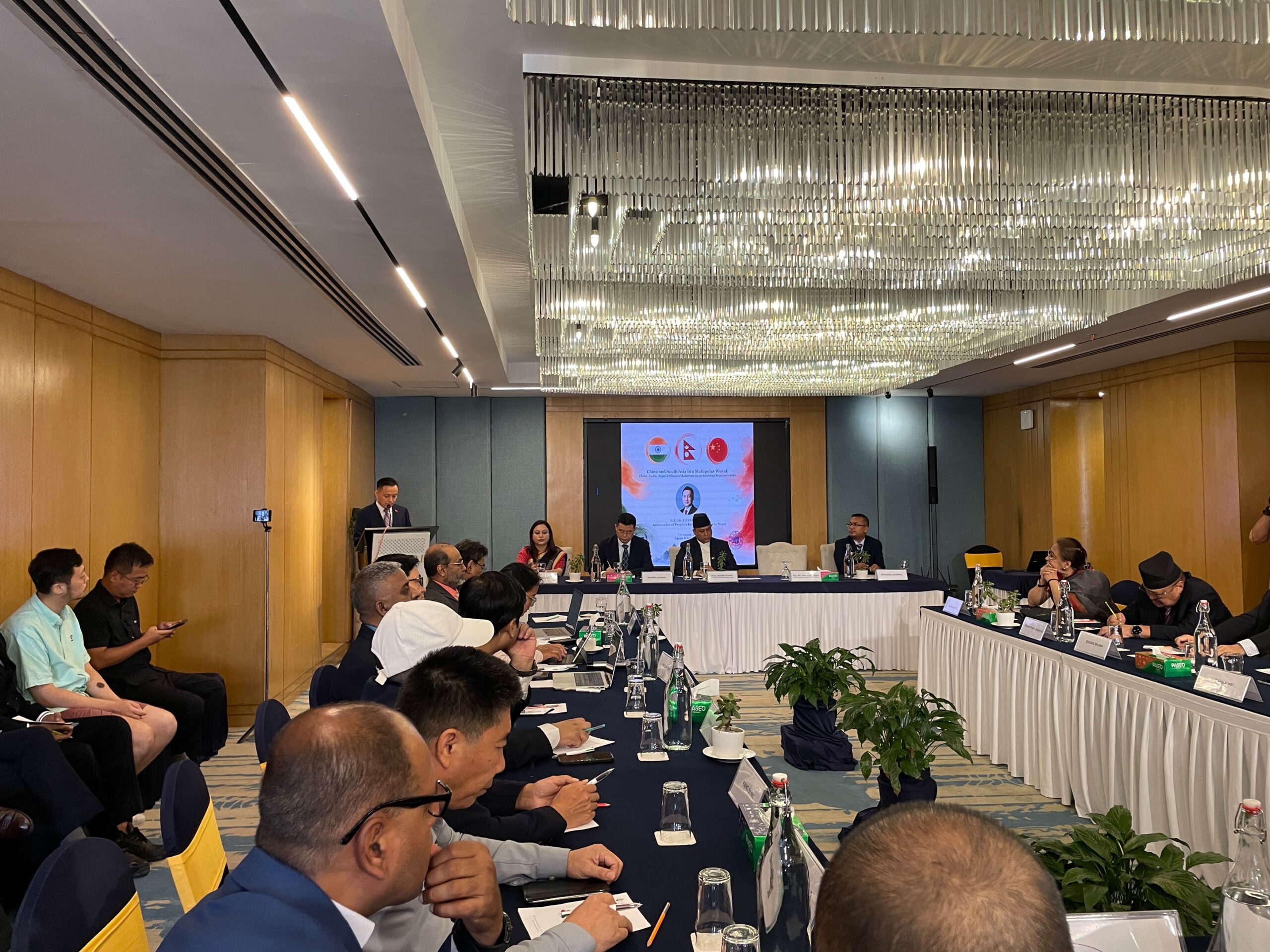
KATHMANDU, August 7 : A two-day international conference titled “China and South Asia in a Multipolar World” commenced today at The Square Hotel in Pulchowk, Kathmandu. The high-level event brings together around 30 distinguished scholars, diplomats, policymakers, researchers, and strategic affairs experts from Nepal, China, and India to deliberate on the evolving geopolitical landscape of South Asia.
The conference is jointly organized by the Center for South Asian Studies at Fudan University (China) and the Nepal Institute for International Cooperation and Engagement (NIICE). It aims to foster academic dialogue and policy discussions on regional cooperation, focusing on trilateral connectivity, security, and emerging challenges in an increasingly multipolar world.
Foreign Minister Khanal Stresses Economic Diplomacy
Delivering the keynote address during the inaugural session, Nepal’s Minister for Foreign Affairs, Hon. Shisir Khanal, emphasized that “Asia’s transformation presents unprecedented opportunities for shared prosperity”. He noted that while South Asia possesses enormous promise, much of its economic potential remains untapped.
“Nepal sincerely welcomes the continued development and prosperity of both India and China and remains committed to further strengthening its longstanding bilateral relations with both neighbours independently, on the basis of sovereign equality, mutual respect, mutual benefit, and sensitivity to each other’s legitimate interests and concerns,” Khanal stated.
Highlighting economic diplomacy as a defining priority for Nepal, Khanal noted that foreign policy must focus on improving the lives of citizens through trade, investment, employment, tourism, technology, innovation, and sustainable development. He reaffirmed Nepal’s goal to transform from a landlocked state into “a vibrant, dynamic bridge connecting China and South Asia” through cross-border transport connectivity, trade facilitation, digital networks, and people-to-people exchanges.
Pointing to Nepal’s comparative advantages—including hydropower potential, biodiversity, tourism assets, and shared civilizational heritage—Khanal stressed that the region’s shared future depends on building practical partnerships for shared prosperity. Concluding his speech, he added, “The future of Asia will ultimately be determined not only by the size of our economies or the pace of technological change, but by the quality of the partnerships we build and the trust we cultivate”.
Chinese Ambassador Highlights Nepal’s Role as a Strategic Bridge
Speaking at the session, H.E. Dr. Zhang Maoming, Ambassador of the People’s Republic of China to Nepal, cautioned that the global order is facing severe challenges due to rising unilateralism, protectionism, and hegemonism.
Amid world order disruptions, Ambassador Zhang highlighted that South Asia has maintained overall stability and economic growth, emerging as an indispensable rising force in the global power structure—a strong testament to the “Asian Century”. He described Nepal as “a vital bridge linking China and South Asia” that plays an irreplaceable role in regional connectivity and practical cooperation.
“2026 marks the launch of China’s 15th Five-Year Plan and the inaugural year of Nepal’s new government, which brings greater opportunities for deeper strategic alignment and integrated development between our two countries,” Ambassador Zhang remarked. He added that China stands ready to work with Nepal on high-quality Belt and Road cooperation, poverty reduction, medical assistance, and cultural exchanges to set an example for regional cooperation.
Promoting Trilateral Engagement and Academic Exchange
The inaugural session was chaired by Ms. Sumitra Karki, Director of NIICE, while Dr. Pramod Jaiswal, Research Director of NIICE, delivered the opening remarks. Dr. Jaiswal suggested that the Government of Nepal consider establishing dedicated support mechanisms for independent think tanks working on foreign policy, strategic affairs, and economic diplomacy, while also recommending the setup of Nepal Study Centers in India and China.
Prof. Dr. Zhang Jiadong, Director of the Center for South Asian Studies at Fudan University, delivered the vote of thanks. He commended Foreign Minister Khanal’s balanced foreign policy approach and noted that historical and Trans-Himalayan cultural affinity must be translated into practical regional cooperation.
Conference Overview
Over its two-day duration, the conference features eight thematic sessions covering:
-
China and South Asia in a Multipolar World
-
Nepal-China-India Trilateral Cooperation & Bilateral Relations
-
Strategic Competition & Security
-
Economic Corridors and Regional Development
-
Soft Power and Educational Diplomacy
-
Nepal’s Internal Dynamics and Foreign Policy
Distinguished participants include scholars and former diplomats from Fudan University, Shanghai Institutes for International Studies, MP-IDSA (India), Jawaharlal Nehru University, Delhi University, Tribhuvan University, Policy Research Institute, and NIICE, among others. The conference will conclude on August 8, 2026.