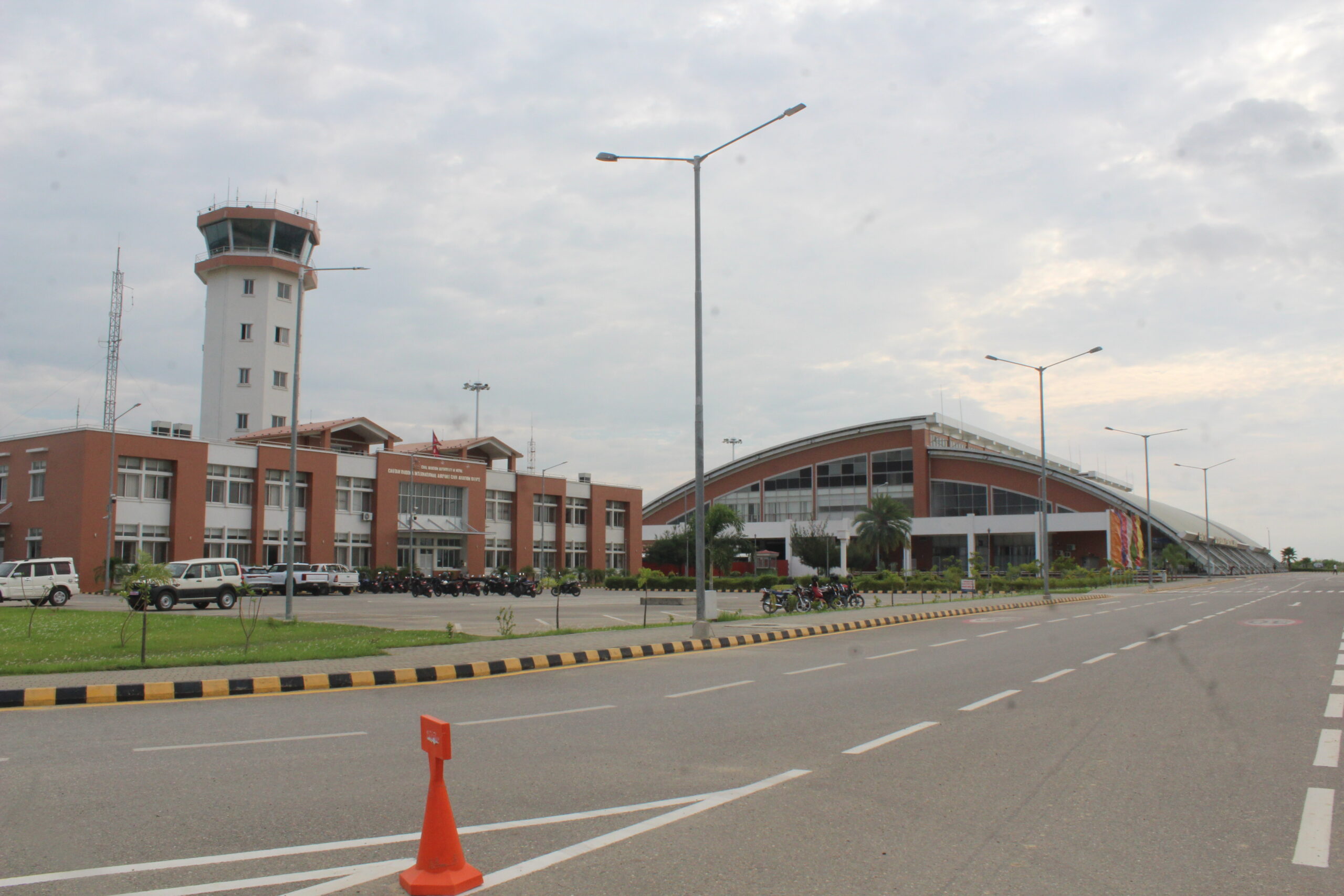
Rupandehi, Nov 26: The possibility of expanding international flights from Gautam Buddha International Airport has increased after Nepal and India agreed to operate the Kathmandu–Bhairahwa–Lucknow two way air route.
The memorandum of understanding (MoU) reached during Prime Minister Balendra Shah’s recent State visit to India, is expected to help remove the air route-related obstacles that were affecting international flights from Bhairahwa Airport.
According to the MoU, efforts are being made to convert the exizting one-way Kathmandu–Bhairahwa–Lucknow (B-345) air route to two-way.
Previously, it was practically challenging to use the route for takeoffs and landings from Bhairahawa.
If two-way operations are materialized, it is expected to make international flight services at Gautam Buddha International Airport easier and provide more options to airlines.
However, further discussions will require regarding technical aspects, flight operation procedures, and necessary management arrangements to execute the MoU.
In this connection, stakeholders have stated that one should not understand it to mean that regular flights started immediately after the MoU.
Netra Prasad Acharya, President of the Siddhartha Chamber of Commerce and Industry, Rupandehi, said the agreement to make the air route two-way should be seen as a positive achievement for the economic development of Bhairahawa and the entire Lumbini region.
According to him, the expansion of international flights will have a direct impact on tourism, industry, trade, and the hotel business.
If the airport can operate at full capacity, the region’s economic activities will become more dynamic, he added.
Sagar Adhikari, former President of the Nepal ssociation of Tour and Travel Agents (NATTA), said expanding air access could make it easier for foreign tourists to visit Lumbini.
He noted there would be a greater possibility to bring tourists from various cities in India to Lumbini via Bhairahawa.
He emphasized improving flight services, tourist packages, and transportation management in order to make airport operations effective.
Prof Suraj Ghimire of Lumbini Buddhist University said the expansion of air routes should be considered in connection with Lumbini’s international tourism.
He argued Lumbini, the birthplace of Buddha, can be linked with Buddhist sites in India such as Bodh Gaya, Sarnath, Kushinagar, and Shravasti to promote religious and cultural tourism.
If flights can be expanded from Bhairahawa Airport, it will be easier to take tourists coming to Nepal to historical and archaeological sites in Kapilvastu, including Lumbini, Tilaurakot, Devdaha, and Ramgram.
This is expected to create employment and income opportunities in tourism-related businesses, as well as in local hotels, transportation, agriculture, and other service sectors.
The Gautam Buddha International Airport was expected to connect Lumbini to the international air network.
However, due to challenges in maintaining regular international flights, the airport has not been able to achieve the expected outcomes.
In this situation, properly implementing the latest MoU between Nepal and India could increase the use of Bhairahawa Airport and also support the promotion of tourism in the Lumbini area.